Focus & distractions
The Focus & distractions section provides insights into deep work, context switching, uninterrupted work sessions, and other factors that can affect focus and team well-being.
To access it, open Work from the left sidebar and select Focus & distractions.
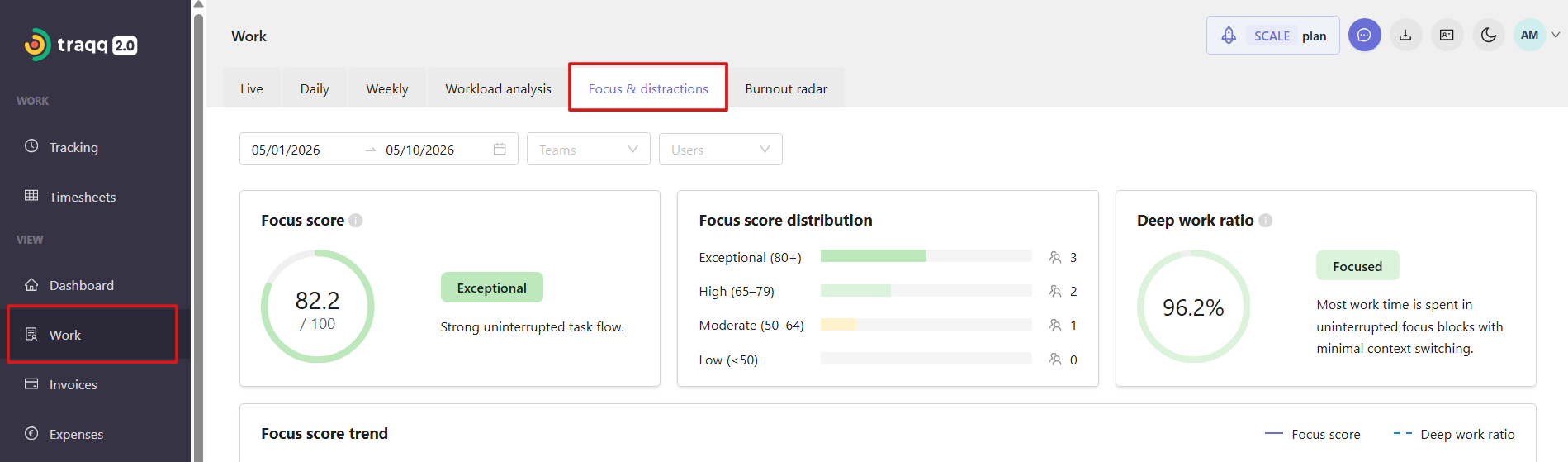
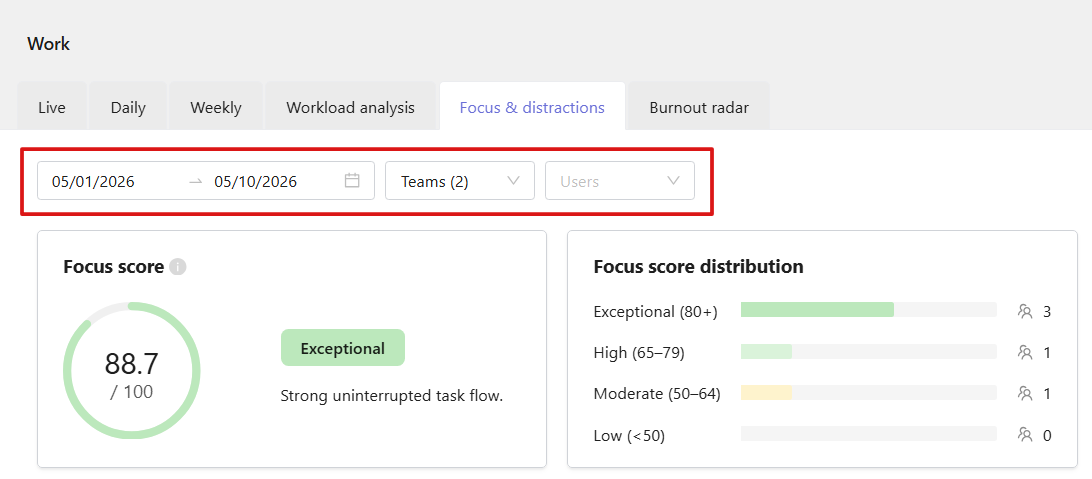
You can filter the data by a specific date range, team, or user.
Data availability
Focus analytics require at least 20 hours of tracked work in the selected period to provide reliable insights.
If there is not enough data, the page shows Not enough data yet. Analytics become available automatically once the required amount of work data is collected.
Focus score
Traqq's Focus score measures how focused your team is. The score ranges from 0 to 100 and is grouped into four categories:
- Exceptional (80+) — Strong uninterrupted task flow
High (65–79) — Mostly focused work
Moderate (50–64) — Noticeable fragmentation
Low (<50) — Work is highly fragmented 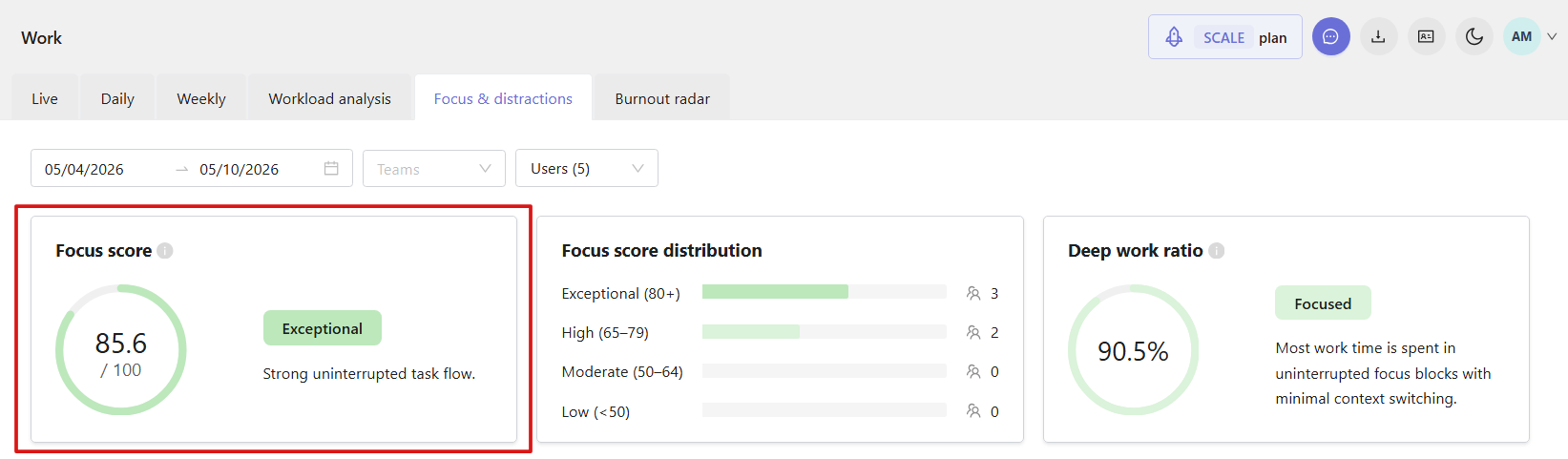
-
Focus score distribution
The Focus score distribution shows how many team members fall into each focus score category.

Deep work ratio
The Deep work ratio shows the percentage of tracked time spent in uninterrupted focus blocks lasting more than 45 minutes, with minimal or no context switching.

The ratio is grouped into three categories:
Focused (70–100%) — Most tracked time is spent in uninterrupted focus blocks with minimal context switching.
Balanced (50–69%) — The team maintains a balance between focused work and interruptions.
Fragmented (0–49%) — Frequent interruptions and task switching leave limited time for sustained focus.
Focus score trend
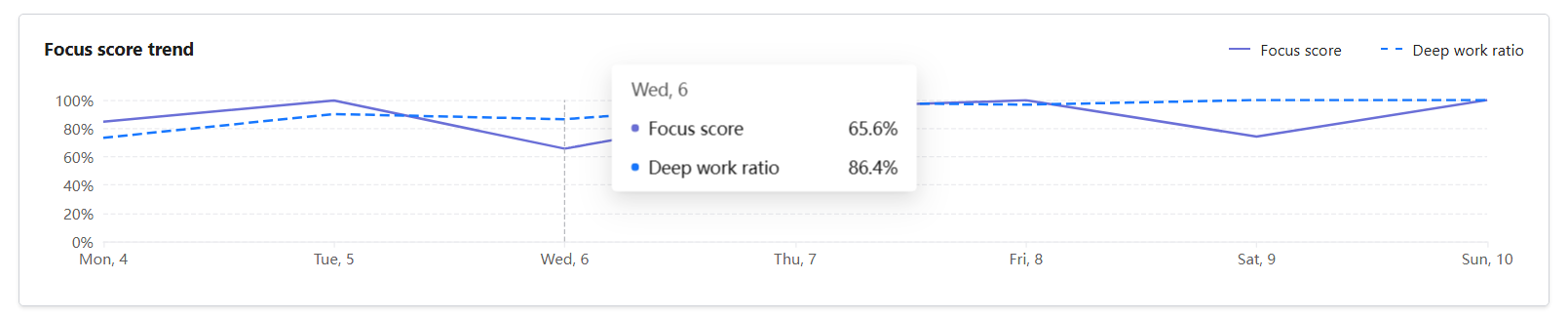
The Focus score trend chart shows how the team's Focus score and Deep work ratio change over the selected period. Hover over the chart to see the Focus score and Deep work ratio percentage for a particular day.
Focus factors
The Focus factors section provides additional metrics that help explain the team's focus patterns:
- Context switches per hour shows how often a user switches between tasks or projects within an hour. Fewer switches generally indicate more focused work.
- Avg uninterrupted session shows the average amount of time spent working without switching tasks or projects. Longer sessions generally indicate better sustained focus.
- Projects per day (avg) shows the average number of different projects a user works on per day. Working across fewer projects can help reduce context switching and support sustained focus.
- - Deep work days shows the average number of days per team member with at least 120 minutes of deep work. More deep work days indicate more consistent focus.

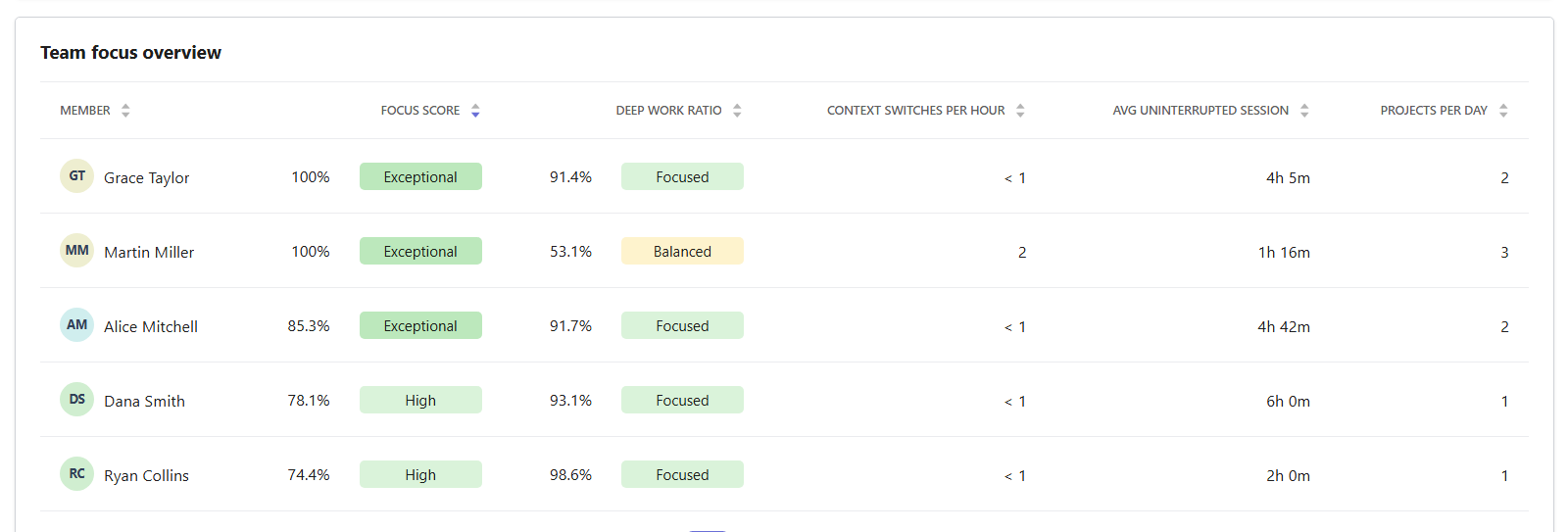
Team focus overview
The Team focus overview provides detailed focus metrics for individual team members, including:
- Focus score
- Deep work ratio
- Context switches per hour
- Average uninterrupted session
- Projects per day
Insights
The Insights section highlights key findings about your team's focus, including focus distribution and changes over time.

FAQs
How is Traqq's Focus score calculated?
Traqq's Focus score measures how consistently a user works on the same task. More time entries for the same task indicate more fragmented work and result in a lower score. The overall score is weighted by tracked time.
How does Traqq define a context switch?
In Traqq, a context switch is a change between different work contexts. This includes switching to another task or project, returning to a previous task, or resuming work after a pause longer than 30 minutes.
What's the difference between Focus score and Deep work ratio?
Focus score measures how consistently a user works on the same task. Deep work ratio measures how much tracked time is spent in uninterrupted focus blocks lasting more than 45 minutes.