Quick Summary
- Invasive time-tracking features can affect productivity, push remote workers to engage in activities that distort the data, diminish workplace trust, and increase turnover.
- Convincing workers that these features do not exist is the best way to secure their buy-in, and adopting a time tracker without those features is the proof they need.
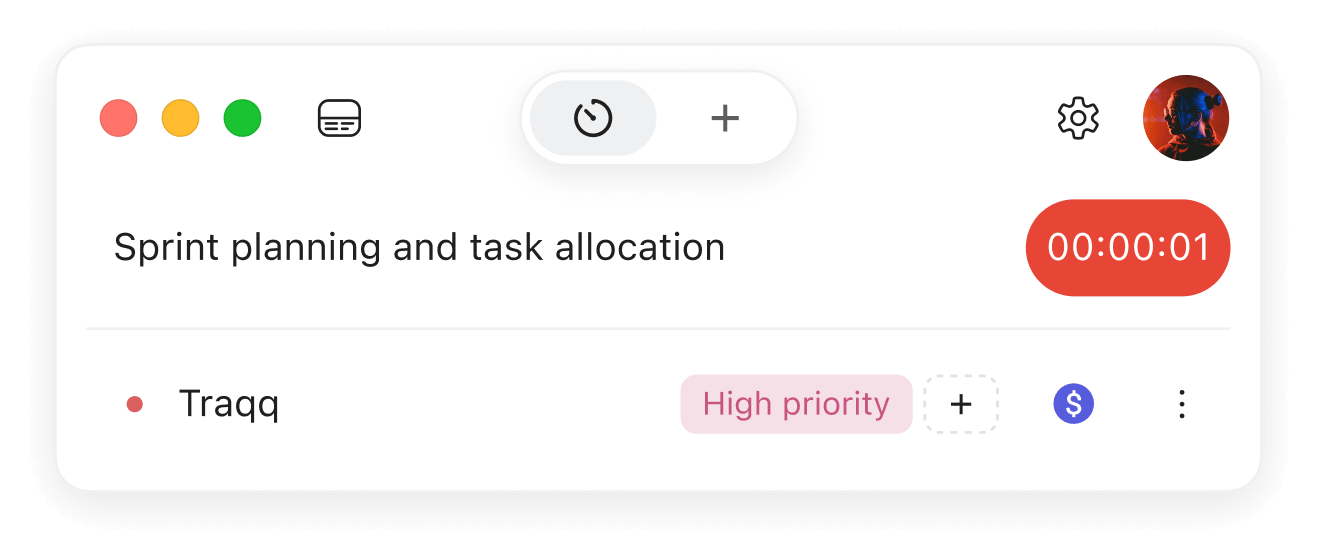
- Traqq does not take screenshots, log keystrokes, monitor location, or capture webcam feed, which makes it the ideal tool for privacy-friendly time tracking.
- However, tracking work hours while respecting privacy also involves announcing the policy upfront, explaining the time-tracking objectives in clear terms, involving workers in deliberations, and providing access to the data.
- Traqq also shows workers the same data their employers have access to.
- The tool runs in the background during day-to-day work activities, allows employees to start the timer themselves or use automatic options, and provides manual adjustment options.
Privacy-friendly time tracking gives employers the best chance of collecting accurate time data. It’s also an effective way to maintain engagement, preserve workplace trust, reduce unnecessary, expensive turnover, and improve productivity.
These outcomes are even more important for remote teams, as collecting data that reflects work realities is critical to managing virtual workforces.
According to Gartner research, working with low-quality data can cost companies up to $12.9 million annually.
But with many modern time trackers offering invasive features, such as screen-capturing and location tracking, employers often lose perspective on which lines to cross and avoid. Using these tools also gives workers reasons to doubt their employers’ motives.
And the suspicion that their privacy is being violated is one of the reasons employees resist time tracking, which can lead to data inaccuracies and other HR problems.
This article explains how employers can avoid employee dissatisfaction and distrust by tracking work hours in a privacy-friendly manner using Traqq.
Transparent Introduction and Implementation
Privacy-friendly time tracking yields benefits only when employees believe their employers’ commitment to privacy. That belief comes from how organizations introduce and implement the policy, from communicating and collaborating with workers to, more importantly, adopting a transparent and privacy-first time-tracking tool.
Clearly communicate the policy and put it in writing
Introducing time tracking to workplaces without adequate notice or explanation, a common time-tracking implementation mistake, can leave employees assuming the worst about the policy.
To avoid that situation, organizations must inform employees in advance of the intention to roll out time tracking, along with the full timeline, which should provide ample transition headroom.
The announcement should explain the reasons for the policy, including the type of data to be collected and how management intends to use and store it.
Codifying those explanations in a written policy assures workers that their employer’s stance on privacy isn’t all talk.
That policy should spell out, in clear, non-technical terms, what the company will track, who can access the data, how long and where employers will keep the data, and what the system will not collect. It should also specify how employees can flag inaccuracies or raise privacy concerns without fear of retaliation.
Workers should have a say
Research shows that employee engagement increases within a short period when employers give workers a voice in the organization. That’s why allowing team members to help set up the time-tracking policy secures their buy-in.
That buy-in, without the need to adjust work behavior, leads to honest interaction with the time tracker, which means the data will reflect work realities. Collaboration also means that workers can share recommendations that will be incorporated into the official time-tracking policy.
Additionally, using Traqq constitutes a major step toward removing doubts about the employer’s privacy commitments. That’s because, among other reasons, which will be explained shortly, it shows workers and employers the same data.
Use a privacy-friendly tool
Traqq is one of those time trackers that do not take screenshots or include other surveillance features, such as keylogging and location tracking, that make employees uncomfortable.
These features, along with the data transparency mentioned earlier, make using it a critical step in securing employee trust. And because the app complies with data protection regulations, such as the GDPR, companies don’t have to worry about regulatory penalties.
In addition to addressing the privacy concerns, it also helps businesses retrieve the data they need to make better business decisions. Its productivity insights include work patterns and activity trends that help employers identify overworked and underutilized employees, manage and distribute workloads better, and understand every worker’s peak work periods.
What Does Using A Privacy-First Tool Look Like for Remote Teams?
Team members who know their privacy is safe use time trackers more honestly, as mentioned earlier. That honest adoption involves using the application in accordance with policies established by companies in collaboration with employees.
However, the way the time tracker operates encourages interaction even more. The following showcases how privacy-first time trackers work in day-to-day workplaces.
The time tracker does not interrupt work
Apart from not taking screenshots or collecting personal data, privacy-friendly time trackers do their best to stay out of the employee’s view. That’s how Traqq works. The lightweight application runs in the background, with minimal impact on system resources and without interrupting the employee.
Most time trackers offer the same out-of-sight feature, but some can come with major interruptions, such as distracting notification sounds and pop-ups.
Automatic and manual tracking options
Traqq allows workers to start and stop the timer manually, but there’s an option to allow the tracker to clock in and out automatically based on what the user is doing. For example, when the computer goes idle, the tool can automatically stop tracking work hours and resume when employees become active again.
Manual timer adjustments
Because certain work activities happen outside computers, Traqq and some other time trackers allow supervisors to manually add time. This feature also ensures workers are duly compensated in cases where they forget to turn on the tracker or use different computers.
Additionally, workers can delete time on their end when, for example, the timer runs for an extended period of idle time because the automatic option, which workers can turn off, is not active to pause the tracker.
Review the time data
Since workers can, through their Traqq dashboards, access the same data as their employers, they get to view their progress in real time during and after work hours. That way, they can flag productivity gaps or inaccuracies, review how they spend their work hours, and also know when to rest, given how much time they’ve already put in.
Why Is Privacy Important in Time Tracking?
Employee monitoring, which is different from time tracking, is already shaping how people view time-tracking policies. Using features that resemble monitoring, such as, as mentioned earlier, keylogging and screen-capturing, only reinforces that view.
But Traqq’s lack of monitoring features, along with other privacy-friendly policies, can change that view and encourage workers to embrace time tracking.
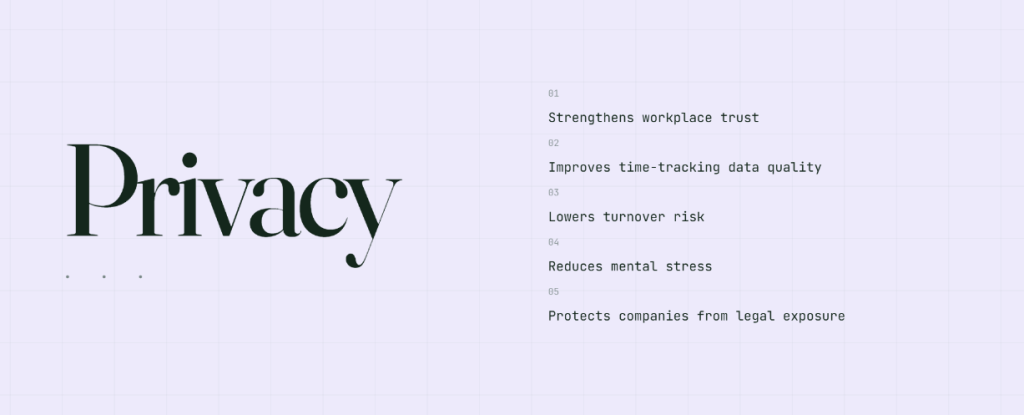
The following further breaks down why privacy-first time tracking is critical, especially in remote workplaces.
Strengthened workplace trust
Employees who suspect they are under surveillance will always feel the need to look over their shoulders. And whether it is the case or not, they will also think their employers do not trust them. When workplace trust, now a performance metric for modern workforces, diminishes due to these concerns, productivity begins to decline.
That suspicion of surveillance does not arise when workers use Traqq, because accessing the same data as employers allows them to verify that the tool lacks monitoring features. So there’s no need to live in fear of privacy violations.
And according to a Slack survey, employees who trust their leaders are more passionate about their work.
Improved data quality
Employees who are worried about surveillance, as mentioned, spend considerable work hours on time-wasting activities, such as censoring screen content. These activities can pollute time-tracking data because they do not reflect the employee’s true work behavior and patterns.
While a privacy-assuring policy helps address the privacy concerns, using Traqq removes the need to engage in these behaviors because, as established, workers can always verify that the program does not monitor them.
When that behavior does not exist, the time tracker will capture what it was meant to measure in the first place.
Lower turnover risk
According to an ExpressVPN survey of 1,500 U.S. workers, almost half (49%) would consider quitting their jobs over surveillance. 24% of the survey’s participants will go as far as accepting a pay cut to work elsewhere to avoid invasive monitoring.
Replacing a departed employee can cost companies up to 200% of their salary. Vacant positions, depending on the role, can also lead to revenue losses.
When companies introduce time tracking with robust privacy protections, they can prevent these privacy-related departures.
Reduced mental stress
Workers who feel like they are being watched always think about being watched. That’s why 56% of those who experience monitoring say they are mentally stressed. This mental stress prevents people from doing their jobs.
Using Traqq in conjunction with strong privacy policies eliminates the likelihood of that kind of mental distress.
Privacy reduces legal and reputational exposure
Depending on an employer’s jurisdiction, there are risks of regulatory fines and bad press when sensitive, personal employee data ends up in the wrong hands. An example is the €32 million fine imposed on Amazon’s French warehouse subsidiary by France’s data protection authority, the CNIL. The fine was imposed for allegations of excessive employee monitoring.
Focusing on collecting only work-related data without violating privacy, which is what Traqq does, allows companies to deal with less red tape and avoid this kind of regulatory and publicity fallout.
Is time tracking the same as employee monitoring?
No. Time tracking and employee monitoring are different practices. While employee monitoring uses software that takes screenshots, logs keystrokes, and captures webcam and audio feeds to observe work activity, time tracking only measures work hours.
Standalone time trackers that take screenshots and log keystrokes are closer to monitoring tools than they are to time tracking.
Why do remote workers resist time tracking?
Because they suspect it monitors them and can collect sensitive personal information. But since Traqq does not collect private data and users can verify that it doesn’t, adopting the tool can help employers dissolve the resistance.
Can time tracking work without screenshots?
Yes. Traqq does not take screenshots, and it provides accurate time-tracking data. Many other privacy-first time trackers, while they do not produce the same data as Traqq, also work without taking screenshots. The screen-capturing feature is available only in time trackers when developers choose to add it.
What should a privacy-friendly time-tracking policy include?
It should spell out what the company tracks, who can see the data, how long and where employers keep the data, and what the system will and will not collect. It should also establish a method for employees to flag inaccuracies without fear of retaliation.
How should employers introduce time tracking to remote teams?
By announcing the company’s intention to use time tracking during the deliberation stages. Employers should also involve workers in those deliberations, use their recommendations, explain why the policy is necessary, adopt a reasonable timeline, and promise to choose a tracker that respects privacy.
Does giving employees access to their own data matter?
Yes. It helps workers verify that their employers are not capturing anything else beyond time-tracking data and that the captured work hours and related data are accurate.
Are there legal risks to invasive employee monitoring?
Yes. Many jurisdictions, such as the EU, have strict data protection laws that limit the extent to which employers can collect and keep personal and sensitive employee data. Failure to comply can lead to fines and other damaging penalties.